Build & design
The Coda W definitely seem most at home on a pair of speaker stands, which is where we have them for the majority of our testing. We settle with the stands about 30cm away from our listening room wall, which ensures plenty of low end but not so much that it begins veering into the mud, so to speak.
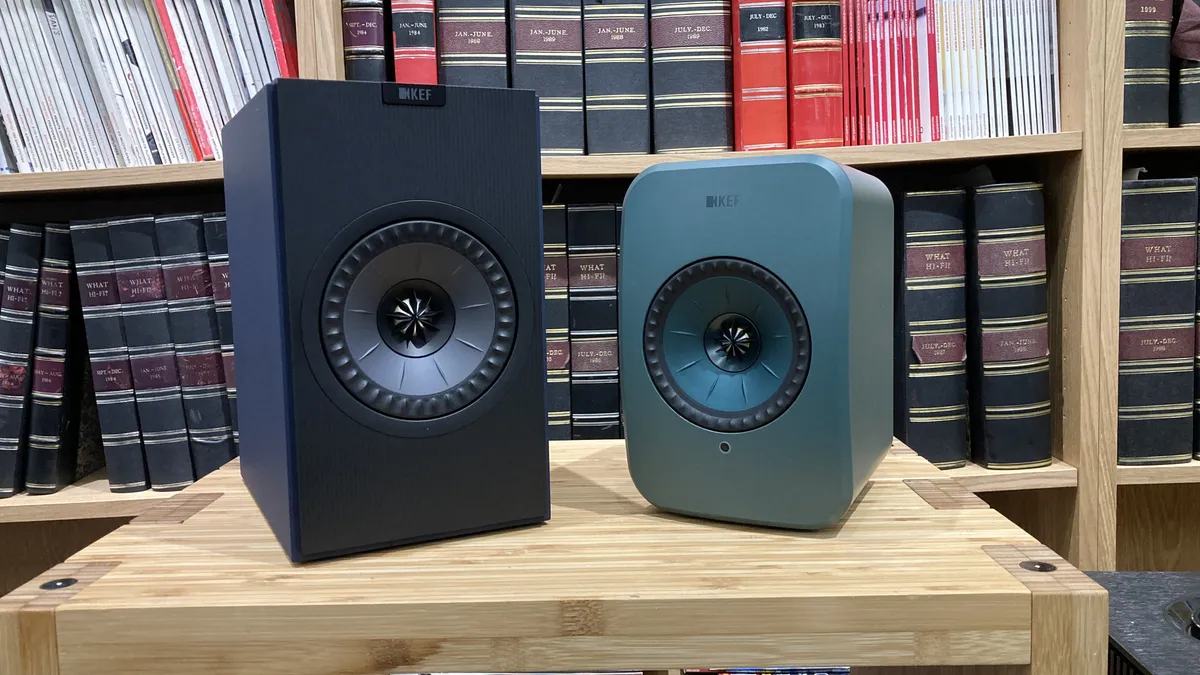
When looking at the Coda W and LSX II LT side by side, the new models definitely have more of a classic speaker aesthetic, owing to their squared-off, rather than curved, edges. Nothing about them feels remotely dated, however. The Coda W are slick and streamlined, while their clean lines give them a minimalist look that exudes a quiet elegance.
The choice of finish options is more understated than loud, but with five to choose from (vintage burgundy, nickel grey, moss green, midnight blue and dark titanium), there should be something to suit everyone’s tastes.
Our review sample is in the midnight blue colour, which looks to have been applied with care as the cabinets are neatly finished. When picking up the Coda W, they also feel nice and sturdy, while the overall build quality is excellent.
Bigger doesn’t necessarily mean better, but it does mean KEF can fit a larger version of its Uni-Q driver array into the Coda W. Uni-Q is KEF’s proprietary driver technology where the tweeter sits in the throat of the mid/bass unit, with one of its claimed advantages being that sound is dispersed more evenly, meaning you can be less fussy about your listening position. We’ve had lots of experience with KEF’s Uni-Q driver array over the years and its claims in this regard ring true.
The 12th-generation Uni-Q fitted to the Coda W has a larger 13cm mid/bass compared with the 11.5cm last-gen unit used in the smaller LSX II LT, which promises improvements to scale, dynamics and bass reach. Look behind the distinctively shaped waveguide in the centre of the Coda W’s unit and you will find a larger 25mm aluminium dome tweeter, too.
Inside, each channel has two Class D amplifier modules, delivering 70 watts to the mid/bass unit and 30 watts to the speaker, respectively. That’s a total of 200W combined from the speakers.
Another similarity is that the Coda W has all the connections packed into one of the speakers that you connect to the mains power. This speaker then feeds power and signal to its pair via a supplied 3m USB-C cable. If you want a wider berth between the two, KEF also offers an 8m lead that you can buy separately.
Features & connectivity
If you’re buying an all-in-one speaker system, you definitely want a good selection of digital and analogue inputs, and the Coda W have enough to satisfy most listening requirements.
The lack of any built-in streaming (there’s no wi-fi, no Spotify Connect, no internet radio) here might be disappointing to some. KEF’s engineers say this is to appeal to customers who want minimal fuss with connectivity, and to keep costs down. To stream tunes wirelessly from your phone or tablet to the Coda W, you can do so via Bluetooth, with support for the aptX Adaptive and Lossless codecs available.
Looking at the back of the mains-powered speaker, you’ll find the aforementioned MM phono input for a turntable, and an RCA line-level for hooking up a CD player or music streamer. An HDMI ARC port means you can use the speakers to enhance your TV’s sound, while an optical input supports high-resolution audio up to 24bit/96kHz.
There is also a USB-C input that supports hi-res audio up to 24-bit/192kHz PCM, ideal for plugging in your laptop or smartphone. Another USB-C port can charge your mobile devices, too.
While we think the Coda W should have enough oomph in the low end to satisfy most listeners, bass junkies will be pleased to hear these KEFs also feature an RCA output for hooking up an external subwoofer.
There are several ways to control the Coda W: the KEF Connect app, the supplied remote control and the touch-capacitive buttons on top of the main speaker. Switching between sources and pairing with Bluetooth is painless, and overall, the speakers are easy to use.
Verdict
KEF has taken a slightly different approach with the Coda W active speakers, but has successfully maintained its recent high standards when it comes to sound quality. While the phono stage could be better, listening via the other inputs is a joy. The sonic performance is a step above its smaller, Award-winning cousins, and costs you less money to enjoy, too.
If you’re happy to live without the wi-fi streaming features and are looking for a neat speaker system that doesn’t cost thousands, this should definitely be on your radar.