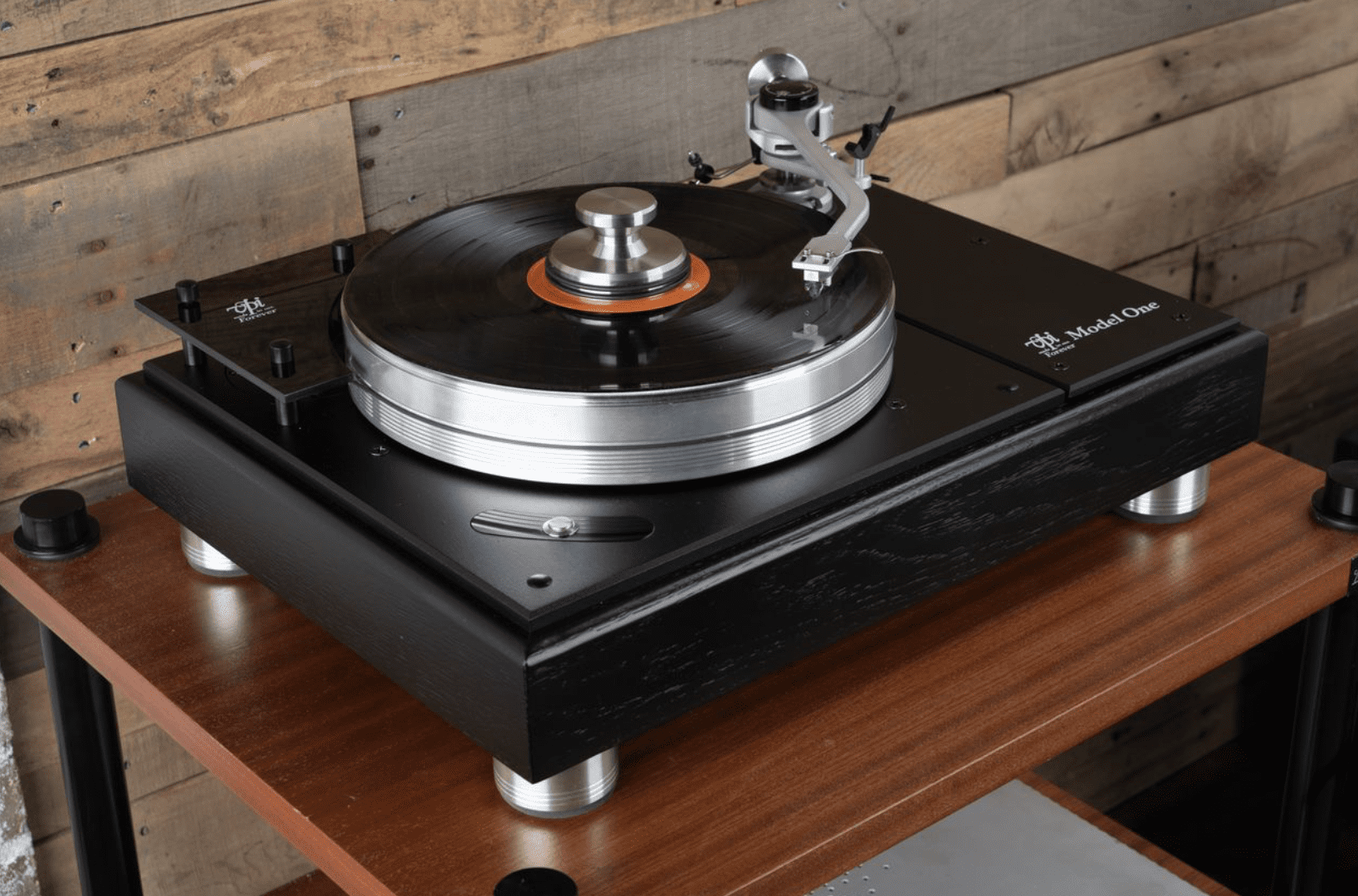
I’ve tested many VPI turntables over the years, but the VPI Forever Model One feels… different. As the name suggests, it’s the first in the new Forever Series, and ‘Forever’ signifies this platform being a long-lasting concept. The more you explore the Forever Series idea, the more it indicates a revolution in the American turntable brand.
There’s an evolutionary element too. Forever remains a fully modular concept; over time, there will be simple drop-in upgrades (such as a Model Two with electronically operated speed control). Nonetheless, newcomers to the VPI line will be able to purchase a new Forever Model One or Two (or more) as standard; they won’t be restricted to starting at the bottom and then progressing upwards.
No problems!
An upgradable turntable is nothing new for VPI; since the original HW-19, the company has offered upgrade paths across its turntable range. But this is different (I keep using that phrase). Forever will likely replace several lines in the VPI portfolio. The Prime Series (Scout, Prime, etc.) and even models in the Avenger Series appear set to be streamlined in the coming months.
In a way, the Forever project and the Model One embody a synthesis of many previous VPI designs, re-imagined for the second quarter of the 21st century. The overall shape echoes the Classic series, but with the modularity of the TNT. The turntable offers the ‘plug and play’ simplicity of the Scout models, combined with the suspension of the HW-19. Forever Model One boasts the solid build of the Prime line, while delivering Avenger-class performance.
This reflection on the past and present is not a bad thing, especially since many of the best models in VPI’s history were much more successful as engineering projects than as finished products. VPI is not alone in this; the advances in engineering tolerances enabled by modern CNC machining have a considerable effect. A good design, built on a wing, a prayer and a lathe from 1980, becomes an exceptional core product when manufactured in a factory equipped with the latest milling machines.
Bouncy?
The most notable aspect of VPI’s history is the Forever Model One’s suspension system. It uses a three-point suspension on its floating subchassis, supported by three inverted Sorbothane ‘bells’ that hold the solid aluminium subchassis with a polymer base. Using Sorbothane instead of springs makes this one of the least ‘bouncy’ suspension systems available, yet it remains highly effective. The subchassis also includes the mount for the inverted bearing and has mounting points for the armbase, should you wish to opt for something other than the new VPI S-Tonearm in the future.
Meanwhile, the AC motor is mounted on the oak frame, and the whole assembly rests on feet sourced from the HW-40 Black Edition. The platter is based on the design used in the Classic and Prime models but is damped with a high-density fibreboard ‘doughnut’ on its underside. The belt surrounds the outside of the platter, and the spindle is positioned at the top left, concealed from fingers or paws by a small cover. There is even a dust cover with removable hinges (which can also be permanently attached).
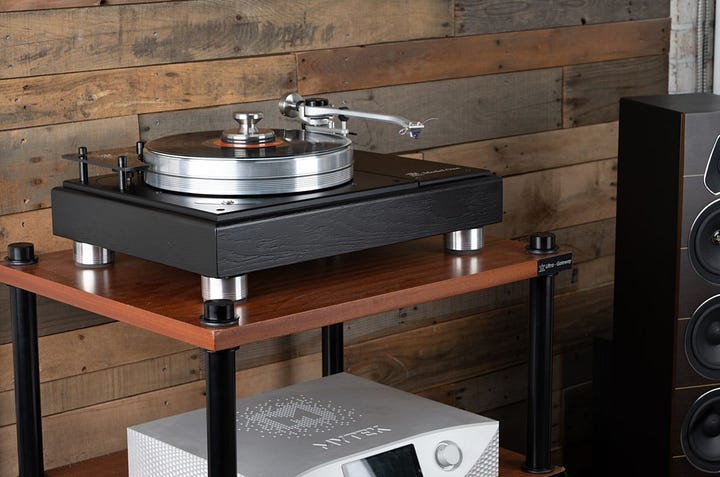

The only exception to the distillation of all things VPI is the tonearm. That S-shaped arm is noteworthy in its own right. The renowned Japanese tonearm manufacturer Jelco was one of the major casualties of the pandemic. The company had reached a point where it needed substantial investment in both staff and engineering equipment, even before 2020. However, the COVID-19 lockdowns ultimately led to the company’s demise. Well, almost; the VPI arm is inspired by the Jelco 750D. Hopefully, if enough people can persuade VPI, this ‘Jelco Reborn’ arm might become available beyond the VPI community.
That isn’t to say this arm doesn’t bear a few VPI fingerprints. Far from it, in fact. Perhaps most notably, the ‘armtube’ is now an ‘arm-bar’; a single, solid aluminium arm with a small, rubber-damped groove milled into its underside for the VPI Reference lead-out wires. Additionally, the VPI company has long been dismissive of anti-skating. While the new S-shaped arm features an anti-skate device, it’s a more basic ‘weights and wires’ design compared to the spring-driven dial-in anti-skate mechanism Jelco used to good effect.
The compliance test
In the Forever Model One, VPI tackles a division in modern vinyl replay. Something was lost during the decade-long pause, from the time when record replay was sharply declining until the early 2000s ‘vinyl revival. ‘ I call it ‘the compliance test’; mention ‘compliance’ to those familiar with LPs before that 1990s downturn, and you’ll likely discuss arm mass and cartridge suspension stiffness. You’ll probably be met with a blank stare by those who discovered vinyl in the 21st century.
Younger enthusiasts never received (nor needed) the information required to form opinions on many aspects of vinyl playback. However, many turntable manufacturers failed to understand this. Nonetheless, VPI clearly did, and the Forever Model One is the result.
The turntable is surprisingly simple to assemble. If you purchase it with the recommended Goldy moving coil cartridge (a modified Audio-Technica) and the VPI-branded, Nordost-made Weisline interconnects, everything arrives pre-set and ready to use. You also receive a stylus gauge included. And best of all, everything comes with just one screwdriver, which is also in the box!
VPI’s Forever Model One is also remarkably well-behaved. While it does have its own dedicated turntable stand, it is so effectively isolated that any appropriately sized sideboard will suffice. Indeed, the straighter it sits, the less you need to do to adjust the feet, but it remains more ‘pragmatic’ and ‘practical’ than many vinyl-loving audiophile fusspots!
Rapper’s delight
Once set up, place the record directly on the platter surface (the included mat acts more as a cover than an interface between the record and the platter). Then, position the record weight over the spindle and press the ‘go’ button. Before we get to the sound, try rapping the top plate with your knuckles while the record is playing. Unless you hit it hard, nothing happens, no sound, no skips. Isolated. Admittedly, you can make it skip if you rap it hard enough, but it will take time to staunch the bleeding from those shattered knuckles of yours.
Perhaps it’s that extraordinary isolation, or that culmination of decades of VPI design, or maybe it’s the way everything comes together in perfect harmony. Still, it took longer to set up the turntable than it did to realise the Forever Model One is something special. Hell, it took longer to write that last sentence… almost. From cold, the table takes a few minutes to settle, and honestly, it was mid-way through the second track I played, the title track of Lana Del Rey’s Norman F**king Rockwell [Polydor], that I recognised I was in the presence of vinyl greatness.
There’s a rhythmic effortlessness to the sound; precise and musically ordered, but without the obsessive, frantic pace or any sense of exaggerated drive. It’s a very quick-reacting deck – transients and vocal plosives are handled swiftly – but there’s no sense of urgency, unless it is called for on the record. In the Lana Del Rey track, her voice is delivered with excellent articulation and dimensionality within a wide, deep soundstage. Some turntables may stumble over this track, occasionally making it seem like she’s singing slightly faster than the backing orchestra, but here the overriding sense of order prevails.
Play something with a more vigorous tempo and a sharp bassline, and you will be equally rewarded. I spent a few hours playing musical ping-pong, eventually settling on ‘What Time Is Love?’ from The KLF’s The White Room album [KLF], where the relentless bassline was played with enthusiasm. Once again, this is a record that can easily overburden a turntable, shifting from ‘relentless’ to ‘frantic’, but the Forever Model One had ample control.
As all good turntables should be, the VPI Forever Model One acted as a musical time machine. I played Casal’s Bach Cello Suites [Archiv], then jumped forward to The D’Oyly Carte and the RPO performing the overture to The Pirates of Penzance [Decca], through Ellington and Brown [This One’s for Blanton! Pablo], and on through ZZ Top [Tres Hombres, London], continuing until I reached Push The Sky Away by Nick Cave and the Bad Seeds [Bad Seed].
On every twist and turn through my back catalogue of records, the same qualities kept appearing on the notepad. It offers a big, expansive soundstage. The VPI is remarkably accurate overall, with bass precision mentioned multiple times. The dynamic range is expressive and reflects what’s on the record — not overpowering, not underwhelming. Detail is outstanding, but like many of the turntable’s features, this becomes clear over time rather than being immediately obvious. Lastly, vocal articulation is excellent.
I have some quite ‘spendy’ turntables on hand (including one from VPI’s own range), and one of the best ways to test a turntable’s true quality is whether you feel pulled towards the ‘better’ deck while it is playing the record under test. Aside from the more obvious observational features… does ‘bigger, better’ tempt you like a siren’s song, or does the turntable that’s actually playing win you over? And it’s here that the VPI Forever Model One truly proves its worth. It’s a straightforward turntable to assemble and easy to ‘tear down’, but I couldn’t—and had no desire to—tear myself away to pack it back into the box. Musical enjoyment is the main goal here, and I found it delightful every time I spun a record.
Modularity function
The only downside to the Forever Model One stems from its modularity. The Model One plays 33rpm records; to play 45rpm requires repositioning the belt. That means removing the side cover, changing the pulley’s position, and then replacing the cover. While this isn’t a big deal (Linn Majik LP12 users still need an adaptor to play 45s), there is a rise in 45rpm albums, and it takes more than a button press to switch to that speed. However, the point where the power button has space for additional push-button speed controls suggests I may have just outlined a feature for the Forever Model Two.
There’s a concept of a ‘Forever’ thing outside of audio. Tired of constantly buying (or leasing) new cars, people are choosing to take a step back and buy something ultra-reliable as their ‘forever car’. Those who’ve had enough of flipping houses often move to their ‘forever home’. In that sense, the VPI Forever Model One is aptly named. I suspect, for many music lovers, this is their ‘forever turntable’. The fact that it can be upgraded when new options and funds permit only cements its permanent status.
Specs & Pricing
Chassis Composition: Wood Skirt with Machined Aluminium top plate
Platter Type & Size: 12” Aluminium, 20lbs
Tonearm Included: VPI S-Tonearm
Motor RPM: 300RPM (US), 500RPM (UK and EU)
Motor Pulley Accuracy: +/- .0005”
Wow and Flutter: .05%
Speed Accuracy: .05%
Rumble: 80 db Down
Footprint (WxD): 50 x 35cm
Overall Size (WxD): 54 x 45cm
Total Weight: 18kg
Price: £6,450 incl tax, €7,500 incl tax, $5,950 exc tax