A former editor at a now-defunct magazine has been posting away on LinkedIn about the demise of luxury audio, how it has no market, how its elderly consumers are a dying breed, and other assorted observations that mostly reflect his own alienation from the higher end of the high-performance audio marketplace. Little of what he claims has any basis in fact, though none of us deny that there are trouble signs ahead for manufacturing of all kinds due to global conditions generally and roadblocks like raw material availability and tariffs specifically. One loudspeaker manufacturer I know, unable to obtain magnets from overseas, had to suspend production for months. That is not helpful for remaining in business!
One of this individual’s most recent and hilarious posts was, “I’m old enough to remember the days when you shopped for stereo gear by picking it up and deciding if it was appropriately heavy.” Does anyone reading this remember ever buying stereo gear by weight? I don’t. Not even Julian Hirsch recommended that method. Of course, I was approaching middle age when this individual was born, so I can go back way further, and I never remember anyone shopping for hi-fi by weight, though unfortunately many do buy audio gear based on price—as in, if it costs more it must be better.
However, his post reminded me of some seriously “weighty” audio gear I’ve reviewed over the years, one of which was Gryphon’s Apex Stereo power amplifier, which is at the extremes of both audio heaviness and at almost three feet long, audio length. Fortunately, no stairs were involved in getting the big black behemoth in or out, though experienced piano movers were nonetheless required to facilitate both. Also fortunate is that while Gryphon’s recently introduced two-chassis Siren Phono Stage is unusually large and heavy, unlike the Apex it does not weigh 445 pounds!
The Physical Plant And The Contents Therein
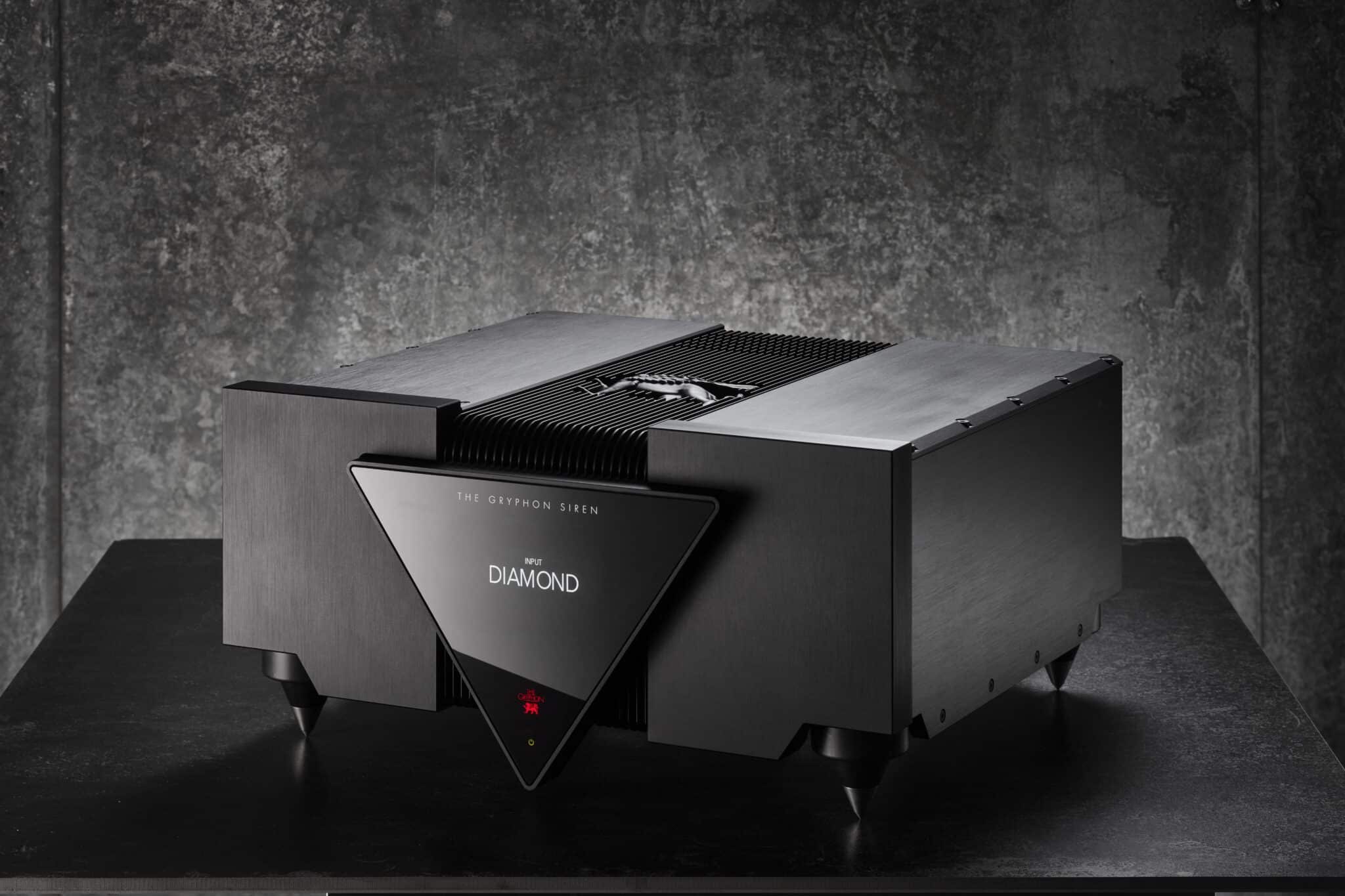
Siren arrives in two large break-down crates, one for the 83-pound power supply that’s as heavy and large (appx. 19″ x 9″ x 18″) as many powerful stereo amplifiers, and the other for the nearly as large, 67.5-pound signal-processing chassis. Like all Gryphon products, the Siren presents itself as an imposing-looking, brooding black entity, wholly appropriate for the sculpted gryphon that holds court atop the chassis. The power supply, featuring an attractive vertically arrayed, curved, mid-section grille is identical to the one supplied with the Commander preamplifier, and here’s the good news for owners of that formidable piece: its power supply is ready to supply the $44,800 Siren. Owners of other preamplifiers will have to add $33,700 to power their Siren, which shares the Commander’s 4.3″ hardened-glass-panel, TFT capacitive touchscreen. For weight-based buyers, Siren plus a separate power supply is an easy choice. Those with other considerations will have to read on!
The Dual-Mono PSU offers what Gryphon says is a “power reservoir whose size and quality are unprecedented in a phono preamplifier” and features local, fully regulated power supplies for all sensitive voltage-amplification stages, plus a discrete one for each channel, and a third specially engineered supply for all digital “housekeeping” functions that keep the digital and analog circuits separate all the way back to the AC cords.
Siren sports quad-layer PCBs with 70µ copper traces that Gryphon claims are twice the thickness of the competition’s. High-quality parts include Mundorf MCap ZN capacitors, Vishay low-inductance resistors, matched ROHM transistors, and ultra-low noise ones from ZETEX. The RIAA circuit uses tight-tolerance Vishay polypropylene capacitors and Vishay SMD precision MELF resistors. Pickering low-capacitance SIL reed relays ensure smooth and quiet input and load switching.
Sensitive audio circuitry floats on a proprietary internal isolation base featuring constrained damping layers of Kerrock, bitumen, and steel, designed to eliminate sonic smearing of fine detail. Capacitors are particularly sensitive to vibrational energy.
The dual-mono-configured circuitry features zero global negative feedback in a fully discrete, fully balanced circuit topology that Gryphon has employed in its phono preamps for more than 30 years. Internal wiring is kept to a minimum. Gryphon uses specially selected PC-mount XLR and RCA jacks. There’s more, but that’s probably enough!

User-Friendly Features and Operational Sophistication
Siren offers four voltage-gain-based inputs: three balanced XLR and one single-ended RCA. There’s a single pair of balanced XLR outputs. Each input can be set for moving magnet with gain settings of 38dB or 48dB and 12 capacitive load settings for moving coil with gain setting choices of either 68dB or 58dB and an unusually wide range of load settings (24) between 20 ohms and 1600 ohms, plus three capacitive load settings. The chosen settings for each input are stored in memory.
From the attractive, machined, black-anodized aluminum remote you can select inputs, adjust resistive and capacitive loading, mute the output, and adjust display lighting. Step away from the front panel, and after a few seconds the screen defaults to the selected input in a large easy-to-see number. Get close, and it automatically defaults to a screen that displays settings and allows access to a menu where you can make other adjustments, including setting gain and naming the inputs. Gryphon’s claim is true that muting and switching between inputs and between loading and gain settings are accomplished smoothly and noiselessly.
DarTzeel Watt Meter Goes Wild!
I ran three cartridges to assess the Siren’s sonics, all on the Wilson Benesch Prime Meridian turntable (same as the company’s GMT minus the active pneumatic suspension): the Wilson Benesch Tessellate Ti-S ($11,500) on the Graviton Ti arm, the Hana Umami Black ($11,500) on the SAT CF1-12 arm, and finally the Gryphon Audio Black Diamond DLC ($20,000) on the Graviton arm. Both the Umami Black and Black Diamond were reviewed on Tracking Angle. Though the Black Diamond was reviewed on a relatively inexpensive ($3469) Ortofon AS-309R arm, the arm and the cartridge produced sonically spectacular results. The DLC resembles the Ortofon Diamond, upon which it is based, but it has a very different sound that’s richer and more fully fleshed out.
The Graviton/Black Diamond DLC combo was, I’ll say upfront, sonically monumental.
But first, the Siren may be the least fussy phono preamplifier I’ve encountered regarding ground hum. There was none with all three cartridges and without paying particular attention to ground wires, though of course the single-ended SAT connection featured a secured ground wire. The complete absence of hum and noise even with volume way up rivaled the black backgrounds of the CH Precision P10 and HSE Swiss Masterline 7 that I reviewed here and Jacob Heilbrunn reviewed for Tracking Angle—and purchased. Though the HSE’s noise spec is considerably lower, the Siren had a similarly notable, ultra-low-noise presentation that went beyond an absence of “hiss” to a sonic place where, on great recordings, layers of low-level detail lurking in the backdrop became clarified (even to older, not-noise-free ears).
As with any highest-of-quality phono preamplifier, the cartridge’s tonal characteristics called the tune here, but the Siren’s macrodynamic presentation on dynamic peaks were off the charts huge. I’ve never seen the watts scale on the darTZeel 468 amps hit the peaks (and differential peaks) I saw (and heard), even on solo piano records, which for some reason is where I started the serious listening, beginning with the Nimbus Records 45rpm Super Analog Mastering Shura Cherkassky Frederick Chopin Piano Recital (Nimbus 45021) a studio recording that has “room ambience” that may or may not be artificially enhanced. Doesn’t matter. I played this one at the Warsaw Audio Fair (naturally), and audiences went wild (almost literally). I played the “Ballade No. 4 in F minor, Op.52,” and, as the annotation notes, Cherkassky played it with “a considered and matured interpretation of muscularity and power.”
Dynamic contrasts both large and small helped produce as natural a flowing presentation of this record as I’ve heard here or anywhere; the smallest scale microdynamic gestures were delivered with a convincing and relaxing ease, facilitating the pianist’s most subtle ideas. I wasn’t particularly listening for that, but they made themselves obvious and helped to both communicate the pianist’s musical and emotional intentions and solidify listener engagement.
The Tessellate’s somewhat stingy and dry lower midrange character and upper-octave clarity and speed were easy to identify, the Umami Black’s generous spatial presentation and upper-midrange generosity were on full sonic display, and especially well-presented was the Black Diamond DLC’s overwhelmingly rich yet well-textured harmonic structure and its detailed expansive scale—almost brutal as Cherkassky dug into the keys toward the piece’s conclusion. It felt like the piano was going to explode!
Readers familiar with the tongue-in-cheek Harmonia Mundi album La Folia wherein conductor Gregorio Paniagua takes the Atrium Musicae De Madrid on an off-kilter Spike Jones-like ride through 17th century Spanish/Portuguese dance music, punctuated by an exploding bottle of cognac, the conductor’s “Bocinetta Peugeot” musical quotes from Mancini’s The Pink Panther, and an Indian raga, know the Harmonia Mundi version (HM 1050), but there’s also a special audiophile edition on the German ATR Master Cut Recording label (ATR 013 LP) that takes the transparency, dynamic range, and soundstaging of the already spectacular original to hyper-extreme levels of spatial and dynamic scale. I used the record as part of a review of a moderately priced high-performance Luxman E-07 phono preamp, and I thought I had a handle on the record’s extreme sonics, but wow! Through the Siren it was another level of extreme.
Though the Gryphon was sensational on all three cartridges, the Black Diamond DLC’s delivery was something else entirely: The soundstage filled and overwhelmed the space where the Wilson Audio Chronosonic XVX speakers sat, seeming to break down and obliterate the side and front walls; the stage was huge, extending alarmingly close to where I was seated, and the speakers seemed to not be playing at all, replaced instead by a gigantic fibrillating musical bubble that you could inflate to gargantuan size by turning up the volume with no loss of musicality, and remaining free of even the slightest hint of edginess or mechanical interference. This was a rare-for-a-veteran reviewing thrill. If you know and love the Harmonia Mundi original try to find this one!
A test pressing arrived the other day by surprise from The Electric Recording Company. Owner Pete Hutchison’s handwritten note said, “I think you could use this test pressing of John Martyn’s Solid Air we’ll soon announce.” The original U.K. Island is a favorite, and on this ERC took the great-sounding original Island to another sonic level. Again, the Siren communicated each cartridge’s essential character, putting each in a most positive light with an effortless sense of non-mechanical musical flow also free of electronic artifacts. Natural, unforced attack, sustain, and decay and timbral neutrality that allowed each cartridge to express its subtle but notable personality.
The recorded sound by John Wood at Sound Techniques is warm and full, aided by this edition’s all-tube vintage cutting system, yet Martyn’s voice never blended into the studio warmth and always presented itself cleanly distinguished from the room, with a full sense of body attached to head, his guitar equally clear yet warm and dynamically expressive. Clapton’s cover of Martyn’s “May You Never” is familiar to most everyone, but the original here is more sweeping and insistent, and I doubt Clapton would disagree. The record through the DLC was visceral and powerfully communicative.
The times when I thought maybe the sound through all three of these cartridges was a tad “rich” was always destroyed with a record on the bright and hard side that sounded so. I figured the Siren was too full-bodied especially via the DLC to do justice to PiL’s Metal Box, highlighted by Jah Wobble’s room-shaking dub bass lines and Keith Levene’s migraine-inducing (in a good way) hard-edged guitar, but no! Instead, the Siren’s song was right on the sonic money, only more intensely delivered both in bottom-end depth and weight and chalk-on-blackboard edge. Best of all you could just keep turning the volume up and up and up, and it only got better!
A lacquer from 1995 of Buddy Holly cut by Kevin Gray for MCA’s “Heavy Vinyl” series that I was involved in, sounded as three-dimensional and “you’re in the studio with Buddy” transparent and alive as I’ve ever heard it. On “Rave On” the transparency and quiet allowed a glimpse into the back of the original studio in Clovis, New Mexico, and I was able to distinguish the different character of the overdubs done at Bell Sound in New York. I’ve never heard this so fully exposed and clarified.
The Siren passed every test I tried to trip it up with. What would happen with Joni Mitchell’s For the Roses? On the opener “Banquet,” instead of the overlay of warmth I was expecting, Joni appeared in thrilling three-dimensional relief, standing well in front of the band with no added warmth, and behind her the piano’s percussive attack and dynamics were better articulated than I’ve ever heard them. “Cold Blue Steel And Sweet Fire” and “Barandgrill”? Never heard them sounding so revealed in three-dimensional space—all of Tom Scott’s reed and woodwind arrangements so clear and weighty yet at the same time fully coherent. The dynamic contrasts of her piano throughout the album were greater and more expressive than I can remember ever hearing them, and I’ve been playing this very pressing since 1972, which makes the record-wear business laughable.
Conclusion
As good as all of these cartridges sounded through the Siren and they all surely did, the combination of Gryphon’s Black Diamond DLC cartridge and the Siren phono preamp produced among the best vinyl playback I’ve yet heard on familiar record after familiar record, particularly in terms of dynamic contrasts and harmonic completeness; however vinyl’s dynamic range measures, for whatever reason, it doesn’t sound much greater on any format than I heard from this combination. For the Roses was the wrap-up album just to cinch the deal, and what the cartridge (and the Graviton and Prime Meridian) pulled from the record and pushed through the Siren produced the best rendering of that record I’ve ever heard. Took me by surprise. So full and rich, yet detailed and rhythmically agile.
To cap off the experience I played the Haitink/BPO Bruckner 7th direct-to-disc record and as Pink Floyd sang, wish you were here. And I wish I could find some fault with how this combo sounded or how the Siren sounded with the other two cartridges, but I can’t. I could go on about some of the other familiar recordings I played through this combo and so greatly enjoyed, but I’m thinking I’ve made the point.
Specs & Pricing
Inputs: Three stereo balanced on XLR jacks, one stereo unbalanced on RCA jacks
Outputs: One stereo balanced on XLR jacks
Input load impedance: mm, 47k ohms; mc, from 20 ohms to 1600 ohms in selected steps
Input load capacitance: mm, 0pF to 608pF in selected steps; mc, 0pF, 220pF or 440pF
Output impedance: 50 ohms
RIAA accuracy: +/-0.1dB
Total power supply capacity, both units: 74,000uF each stereo channel
Gain: mm, +38dB or +48dB@1kHz; mc, +58dB or +68dB@1kHz
S/N unweighted 20-20kHz: mm, 86dB@10mV; mc, 70dB@0.5mV
S/N A-weighted 20-20kHz: mm, 90dB@10mV; mc, 74dB@0.5mV
Dimensions: Siren unit, 480mm x 236mm x 455mm; PSU unit, 480mm x 236mm x 440mm
Net weight: Siren unit, 30.4kg; PSU unit, 38kg
Price: Siren, $44,800; PSU, $33,700
GRYPHON AUDIO DESIGNS APS
Industrivej 10B
DK 8600 Ry, Denmark
(+45) 86891200
gryphon-audio.com
GRYPHON AUDIO N.A. (U.S. Director, Sales and Marketing)
(201) 690-9006
anthony@gryphon-audio.dk
Associated Equipment (for this review)
Turntable: Wilson Benesch Prime Meridian
Tonearms: Wilson Benesch Graviton Ti, SAT CF1-12
Digital: dCS Vivaldi One SACD Player/DAC/Streamer
Preamplifier: darTZeel NHB-18NS
Power amplifier: darTZeel NHB 468 monoblocks
Phono preamplifier: Gryphon Siren
Phono cartridges: Wilson Benesch Tessellate Ti-s, Hana Umami Black, Gryphon Black Diamond DLC
Loudspeakers: Wilson Audio Specialties Chronosonic XVX, Loudspeaker
Cable and interconnects: AudioQuest Dragon & TARA Labs The Zero Evolution, Stealth Sakra and Indra (interconnects), AudioQuest Dragon, Thunder and Dynamic Design Neutron GS Digital (A.C. power cords)
Accessories: AudioQuest Niagara 7000 (line level), Niagara 5000s (amplifiers) CAD Ground Controls; AudioQuest NRG Edison A.C. wall box and receptacles, ASC Tube traps, RPG BAD, Skyline & Abffusor panels, Stillpoints Aperture II room panels, Stillpoints ESS and HRS Signature stands, Thixar and Stillpoints amplifier stands, Audiodharma Cable Cooker, Furutech Record demagnetizer, Orb Disc Flattener, Audio Desk Systeme Vinyl Cleaner Pro X and KLAUDIO KD-CLN-LP200T record cleaning machines, full suite WallyTools